Twin Motors in a 1:18 Truck: A Built ProPulse Twin Motor Conversion (60-9514)
October 23, 2026
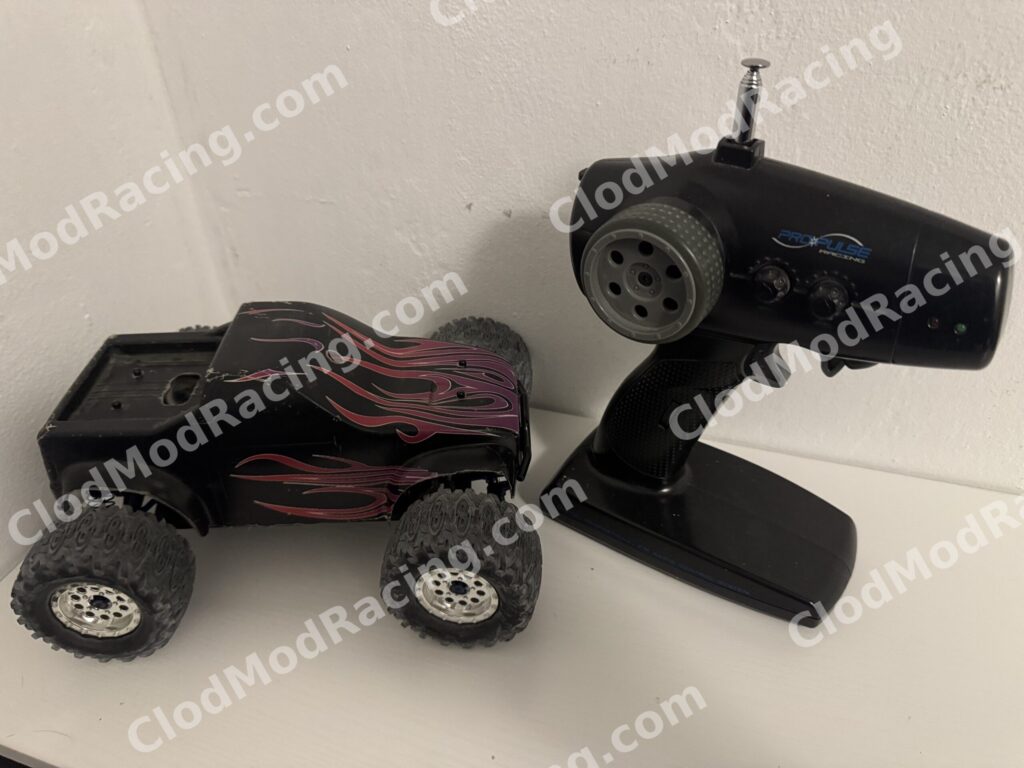
If you read the ProPulse User’s Guide’s upgrade pages, one hop-up got top billing: the Twin Motor Conversion Kit, part 60-9514. It was the factory’s headline performance option for the 1:18 buggy and truck — a second motor, a finned heat sink, and the mounting hardware to run two motors side by side in a chassis that was designed around one. Plenty of kits were sold as shelf candy. Very few were ever actually built.
This truck is one of the few. It’s a built ProPulse 1:18 truck running the full twin motor conversion, and it survives complete — motors, hardware, electronics, body, and radio — which makes it worth documenting properly, because a built example tells you things a sealed blister pack never will.
What’s actually in the truck
Start at the motor plate, because that’s the whole point of the car. Two motors sit side by side: one blue “Performance” motor and one silver motor carrying the ProPulse label, exactly the pairing the conversion kit supplied. Over them sits the kit’s blue finned motor heat sink, there to pull heat out of two motors working in a small, enclosed chassis — run one of these hard without it and you’d cook both cans in short order.
The chassis around the motors is dressed in the rest of the period hop-up catalog. The suspension arms are blue anodized aluminum, a serious step up from the stock plastic pieces, hung on black coilover shocks. The electronics are the standard ProPulse setup the conversion was designed to work with: the ProPulse receiver, still wearing its yellow CH 4 crystal tag, and a blue 7.2V NiMH battery pack on Tamiya-style connectors — the same connector the cars shipped with, and the one most owners already had chargers for.
On top sits the black truck body with its red and pink flame decals, and the package is rounded out by the ProPulse pistol-grip transmitter the truck was run with. The tires are the knobby off-road pattern the trucks shipped on; nothing about this car is a shelf-queen restyle. It was built to be driven, and the spec says it was.
Why a built one matters
Twin motor conversions were a known quantity in bigger scales, but in a 1:18 RadioShack car they were always more brochure than reality. The kit cost real money on top of a car that was already at the top of its price class, the installation was a genuine evening’s work, and the payoff — more torque and punch in a truck that was quick to begin with — mostly appealed to the owners who were already deep into the platform. Most of those owners have long since scattered. The cars got parted out, the kits got separated from the trucks, and the knowledge of how it all went together went with them.
That’s the value of a surviving built example: it’s the instruction sheet made real. How the motors sit, how the heat sink mounts, how the wiring routes, which supporting parts the original owner chose — all of it is visible in a built car in a way it simply isn’t in the catalog drawing. If you’re restoring a ProPulse or building a twin motor truck today, this is the reference.
Building one today
Start with the kit itself. We stock the factory Twin Motor Conversion Kit (60-9514) new in its package, and that’s the right foundation — the heat sink and mounting hardware are the parts that are hardest to substitute. Budget for the supporting pieces while you’re at it: the conversion works the stock drivetrain harder, so check your spur and pinion gears before the first run, not after, and make sure your battery and connectors are up to feeding two motors. Take the truck’s gear mesh seriously, too — the User’s Guide’s mesh procedure matters twice as much with twice the motor. The full guide, including the factory’s own motor-upgrade pages, is scanned in our Manual Library.
This truck stays in the collection — it’s not for sale, and neither is the brushless car in the companion piece. But the parts to build your own are on the shelf, and that’s rather the point of documenting this one.


