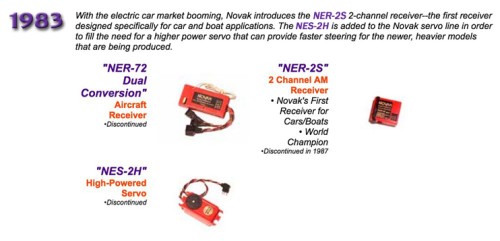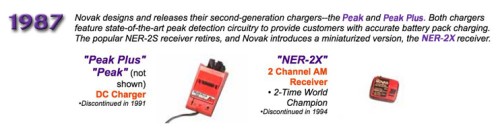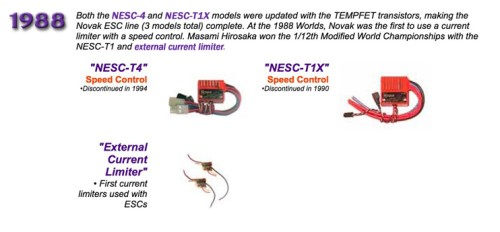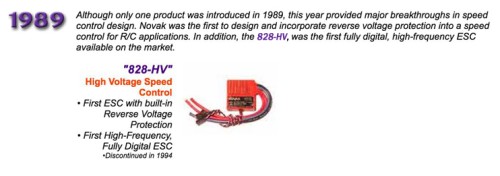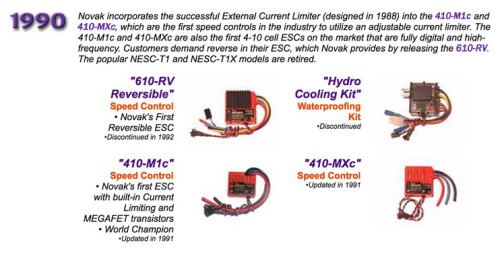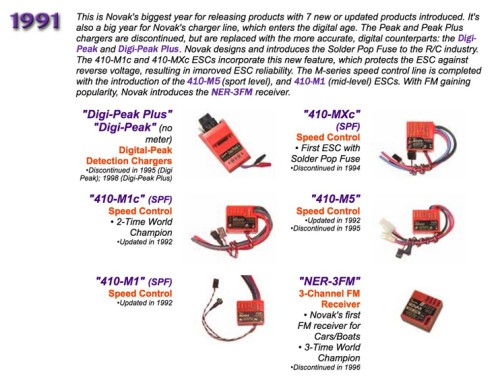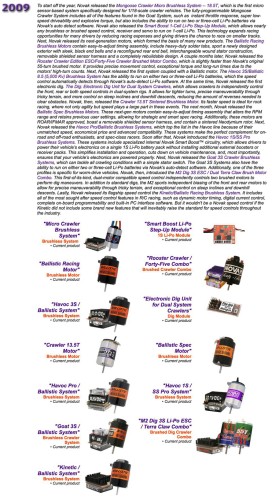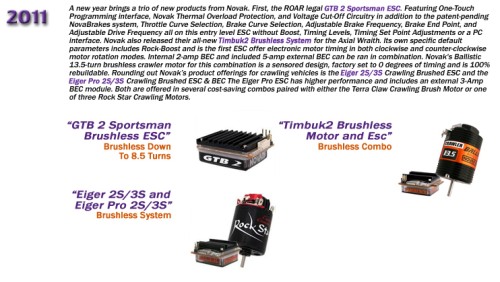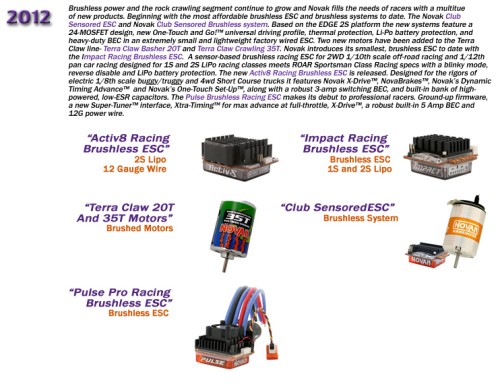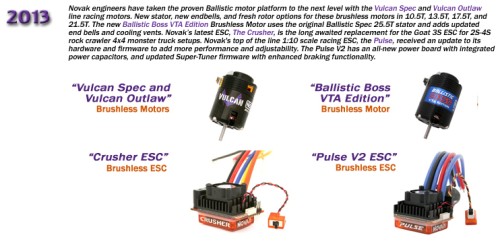
Novak esc timeline history

A Full Narrative Timeline: The Rise of NovaK Electronics

In the languid heat of Southern California, where the pavement shimmered with the echo of high-revving engines and the faint crackle of ozone from sunlit circuitry, a garage door creaked open to reveal a world that would someday power race cars around the globe. This is the story of NovaK Electronics, a company born from curiosity, stubborn engineering, and the patient devotion of a family that believed speed could be tamed and shaped by precise signals, careful design, and a community that ate, slept, and dreamed about RC racing.

What follows is a fictionalized, narrative reconstruction inspired by the arc of Novak Electronics and the broader RC electronics culture. It blends plausible events—technical milestones, product evolutions, and the social fabric of the racing scene—into a cohesive story that can stand on its own, while nodding to the real spirit that once animated a garage-born brand.

The Quiet Fire in the Garage

It began with a spark and a steady hand. Bob Novak, a gifted electrical engineer with a taste for the delicate mathematics of control theory, had grown enamored with the intersection of power, signal, and motion. He wasn’t chasing the thrill of flight alone; he was chasing the possibility that tiny servos and intelligent speed controllers could translate human intention—finessed throttle, precise steering—into machines that could compete, endure, and delight.

Bob’s background was a tapestry of early experiments, classroom lectures, and the hum of practical problem-solving. After college, he gravitated toward RC aircraft, where the challenge was already a negotiation between weight, inertia, and the stubborn physics of air. But the real turning point lay not in the skies above, but on the track below—a culture that celebrated how the slightest adjustment could shave a second off a lap time. It was in those moments of discovery that Bob realized something fundamental: the same servo and the same control principles that made a model airplane sing could revolutionize how RC cars and trucks behaved on the ground.

In those early days, the garage was a sanctuary: a workbench, a soldering iron, a handful of magnifying glasses, a stock of resistors, capacitors, and small motors, and a notebook filled with circuit sketches. The space pulsed with possibility. The family—Joan, his steadfast partner in life and work, and their daughters Linda and Laura—shared the dream not as spectators but as integral participants. The kitchen table became a planning room; the dining room table housed crates of components; and the tiny lamp on the workbench cast a halo over a growing collection of prototypes and tests.

The Bantam Midget: A Small Servo with a Big Bite

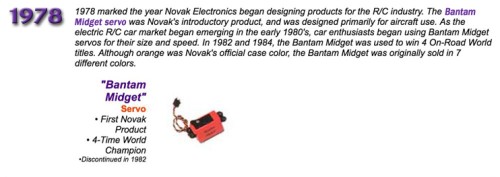
The nascent company began with servos designed for speed and compactness—the kind of product that could ride inside a 1/12-scale on-road chassis and still leave room for other vital electronics. The Bantam Midget servo emerged as a star in those early days. It wasn’t merely about being fast; it was about a rational balance—low inertia, crisp response, and a relationship with a controller that felt almost telepathic to a driver who had learned to read the subtle timing of a radio pulse.

The Bantam Midget found its audience in the on-road racing ranks—cars that needed quick, predictable steering and throttle action in tight, technical sections. In a world where a driver’s fingers and a machine’s electronics had to operate in near-symbiosis, this small servo became a trusted partner, beloved for its clarity of motion and its palatable, nearly ritualistic reliability. It wasn’t glamorous in the sense of a world-changing invention; it was a quiet workhorse, a piece of a larger system that over time would become indispensable to serious enthusiasts.

Joan, with a practical eye for the business of making parts that could be trusted and easily serviced, kept the operation anchored. Linda and Laura absorbed the rhythms of the workshop, learning how a design choice ripples through manufacturing, distribution, and community. The family found themselves in a shared craft—manufacture, testing, and the patient art of talking with racers who used these devices to chase their own versions of speed.

From Servo to System: The NESC-1 and the First Signs of a Brand

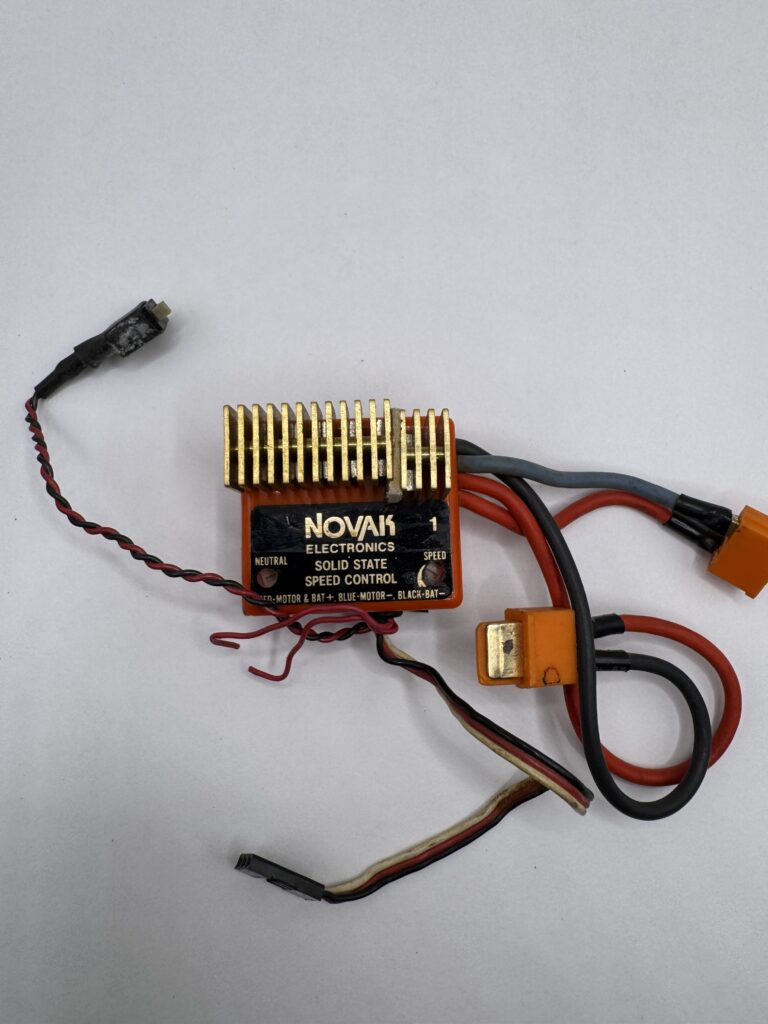
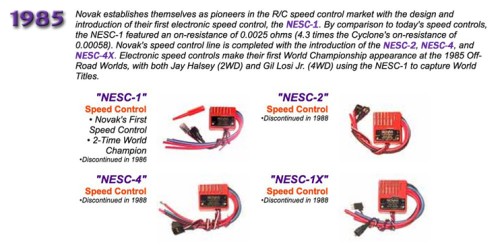
As the workshop grew, so did Bob’s sense that speed and control could be unified by intelligent systems rather than a series of discrete parts. The first sign of this shift appeared in the experimental development of an electronic speed controller designed for on-road racing conditions—the NESC-1. It wasn’t the first ESC of its era, but it carried a distinct personality: a design that prioritized a stable throttle curve, predictable transition between microcontrollers and motors, and a protection system that would save the electronics from the catastrophic failures that could end a race weekend early.

The NESC-1 was more than a circuit board with a few programmed microseconds of delay. It represented a belief that a controller could be a partner to the driver, translating intent into a smooth, repeatable throttle profile that mitigated wheelspin, mitigated the risk of overheating, and allowed drivers to focus on technique rather than constant tuning minutiae. It was the beginning of NovaK’s reputation for building not just components, but coherent, dependable systems.

The orange hue that began to appear on enclosures—bright, unmistakable, and vivid—took root as a branding cue. The orange case wasn’t merely cosmetic; it was a signal of identity. A racer could spot a NovaK component on a crowded bench or pit box at twenty paces and quickly know: here is something designed to be used under pressure, something that would stay cool under heat, and something engineered to be intuitive enough to keep a driver’s attention on the track rather than the manual.

The Orange Era: A Workshop Becomes a Company

By 1980, the operation had matured from a garage workshop into a modest commercial space on Orange Street. The move signified more than a lease; it signified a transition from a hobbyist’s tinkering to a real manufacturing enterprise with a growing list of customers and a reputation to protect. The orange enclosure—bright, practical, and easily recognizable—became part of the brand’s ethos. It was a badge of resilience: a car on a track in bright sun, an orange-lit box sitting on a race bench, a driver trusting his car to a system that had earned the right to be in the hot seat.

At this stage NovaK’s focus was still narrow, but the ambitions were expanding. More precise servos, better-tuned ESCs, and the first inklings of telemetry-friendly components began to appear in the catalog. The company began to sponsor local races, to host clinics, and to build a network of hobby shops that would stock and support their gear. The community around NovaK grew in parallel with the company’s product line: racers, engineers, enthusiasts, and shop owners who believed that good equipment mattered as much as good technique.

The family remained deeply involved. Linda and Laura, who had watched their father’s methodical approach to problem-solving become a family vocation, found themselves learning the language of manufacturing: how to read a bill of materials, how to forecast demand, how to manage the delicate balance between supply and the expectations of a racing calendar that never stood still.

The Golden Era of Certification and Expansion

As the 1980s progressed, NovaK’s trajectory began to resemble a carefully plotted ascent. The company began formalizing quality processes, recognizing that the world beyond their home enjoyed a growing appetite for reliability and track-side support. The NESC-1’s success spurred the team to explore new products designed with the same principles: precise, reliable, easy to service, and accessible to a broad spectrum of racers.

Meanwhile, racing remained the beating heart of NovaK. Local tracks turned into testing grounds, where prototypes were pushed to the edge of their thermal envelopes and tuned for the particular demands of different tracks and weather conditions. The endurance of a good racer meets the endurance of a good electronic system: both depend on the ability to withstand chaos, to recover quickly from a misstep, and to deliver consistent performance when it matters most.

In those early years, a user-friendly tuning interface began to crystallize as a feature set that mattered. Not every racer wanted to become a computer scientist; they wanted to race. NovaK answered by designing calibration tools that translated complex control theory into a language that a driver could understand—grams, degrees, and microseconds—without requiring a degree in engineering to operate. The aim was to empower drivers to tailor throttle response, steering feel, and power delivery to their own hands and to the unique demands of their machines.

The turn of the decade brought international curiosity about NovaK’s approach to RC electronics. European and Asian racers began to discover the brand through regional distributors and sponsored events. The challenge was not only to export product but to export a philosophy: a commitment to reliability, consistency, and service that could survive the long, often brutal journeys to far-off tracks.

NovaK began laying the groundwork for regional distributors, balancing the need to maintain technical support with the realities of shipping, warranty claims, and the logistics of a world where a single good servo could win the first heat or the main event. The company’s testing regime grew more rigorous. Prototypes were tested across a range of environmental conditions, from desert dryness to coastal humidity, to ensure that every product could survive the stresses of a racer’s itinerary.

During this period, the company also started to formalize a quality assurance program. It wasn’t about chasing certification as a branding badge alone; it was about ensuring that every unit that left the factory would perform identically to the last in the field. When a racer trusted NovaK gear to deliver precise, repeatable control, NovaK’s QA program became not just a process but a promise.

The 1990s: Modular Minds and a Growing Family of Systems

If the 1980s were about proving the concept of a dependable, race-ready electronics ecosystem, the 1990s were about building a modular, upgradeable future. NovaK introduced a family of modular electronics: interchangeable ESCs, servos, and sensor modules designed to be swapped or upgraded without replacing the entire system. This modular approach enabled racers to adapt to changing rules, new motor configurations, or evolving chassis designs without discarding an entire platform.

With modularity came a new era of customization. Teams could select from a suite of servo options tailored to different weight classes and track demands, pair them with ESCs that matched their motor choices, and pepper in sensor modules that provided telemetry data for practice sessions and race preps. The ecosystem became more than a product line; it became a toolkit for engineering better performance on the track.

In parallel, NovaK’s design language matured. Updates to enclosures emphasized heat management and durability. The orange cases, once a bold accent, were now a symbol of a disciplined engineering program: consistent ceilings for temperature, robust connectors designed to survive rough handling, and standardized interfaces that made field repairs less painful.

The team grew. Bob remained the steady hand at the helm, guiding decisions with a blend of pragmatism and a keen sense of where the sport was headed. Joan oversaw manufacturing, supply chains, and customer service with a calm authority that kept operations humming even as demand rose. Linda and Laura—now seasoned observers of the business’s arc—began to contribute more directly: shaping product usability, writing user guides, and representing NovaK at racetracks and trade shows. They were not just witnesses to the brand’s growth but active participants in its ongoing evolution.

The Turn of the Millennium: Global Footprint and Firmware Frontiers

As the new century opened, NovaK’s global footprint became more tangible. European distributors expanded the company’s reach, Asia opened new avenues for supply and support, and North American teams continued to rely on NovaK’s reliability during the high-stakes, regional championships. The brand’s identity—orange enclosures, a reputation for robust customer support, and a track-tested philosophy—became a recognizable standard on international tracks.

Firmware became the battleground for performance. NovaK introduced downloadable updates for ESCs and sensor-driven feedback loops, enabling racers to fine-tune torque curves for varying motors and track surfaces without needing to physically swap hardware. The idea was to keep cars inside their comfort zones while still pushing the envelope of what was possible through software alone.


The company also embraced a broader narrative about data. Telemetry and data logging, once a novelty, started to inform practice sessions and race strategy. Teams would bolt on small sensors to capture grip data, motor temperatures, and battery health indicators, then translate that information into adjustments to gearing, throttle mappings, and braking strategies. NovaK’s role shifted from simply building components to enabling data-informed performance, a bridge between the human urge to race and the machine’s insistence on precision.

Trials and Triumphs: The Track Becomes a Classroom

If there were a single truth that underpinned NovaK’s success, it was this: reliability compounds. The more a brand proved its reliability under pressure—in practice sessions that run late into the night, in regional and national championships, in the grueling endurance formats—the more trust racers placed in it. NovaK became a partner in a racer’s education: not only a supplier of parts but a facilitator of learning—about heat management, current draw, sensor fusion, and the subtle nuances of how a given chassis would behave with a particular ESC’s throttle response.

The company’s support network grew to meet the demand. Field technicians traveled to major races, offering real-time troubleshooting, spare parts, and quick-turn repairs. Technical notes and troubleshooting guides proliferated, helping teams replicate setups and diagnose issues long after a race weekend ended. The track, with all its chaos and drama, became NovaK’s classroom and stage, a place where engineers could observe how theory interacted with real-world constraints.

The Nurturing of a Racing Community

People—racers, shop owners, and young enthusiasts—were the lifeblood of NovaK. The brand’s culture encouraged open sharing: tuning tips traded across pit benches, firmware notes discussed in online forums and at trade shows, and the gentle, persistent reminder that great speed requires discipline, patient iteration, and a respect for safety.

In those circles, NovaK became more than a name on a box. It stood for a philosophy: build tools that empower drivers to push their limits without losing control, provide service with empathy and speed, and maintain a transparent relationship with the community. The brand’s orange cases stamped onto pit tables and race benches—flickering in the glare of track lights—signaled a promise: that this equipment was built to serve the racers who trusted it.

The Modern Era: Upgrades, Telemetry, and a Global Strategy

By the 2010s and into the 2020s, NovaK’s ecosystem matured into a robust platform that supported a wide range of scales—from 1/10 to 1/8—and a spectrum of racing formats. The company introduced more precise sensors, higher-channel controllers, and more refined thermal models. The hardware was complemented by software that could interpret data into actionable recommendations: when to back off a current limit to preserve motor life, how to adjust torque curves for a slippery track, or how to tune for a corner exit that demanded instant responsiveness.

Heat management remained a cornerstone of engineering. In a sport where the difference between podium and pit box often boiled down to a few degrees of temperature, NovaK’s focus on enclosure design, cooling pathways, and connector durability helped drivers keep their cars within safe operating margins even under the most punishing racing conditions.

International expansion continued. Distributors dotted the map across Europe, Asia, the Americas, and beyond. The branding remained instantly recognizable—a bright orange case, a clear, well-documented user experience, and a commitment to service that traveled as reliably as the parts themselves. Local support centers and field technicians ensured that a racer on the other side of the globe could get timely help, replacement parts, and guidance to get back on track.

People, Principles, and The Promise of Speed

Bob Novak: The founder who believed that precise signals could govern speed as surely as gravity governs a falling object. His leadership fused technical depth with hands-on mentorship, a quiet insistence on reliability, and a willingness to experiment with new ideas that could redefine what the team thought possible.

Joan Novak: The operational spine and a grounding force. Her eye for manufacturing discipline, supply chain resilience, and customer empathy kept the business connected to the realities of running a global electronics company while preserving its intimate origins.

Linda and Laura Novak: The daughter duo who bridged generations of knowledge. They helped translate engineering complexity into accessible tools, wrote guides that demystified tuning for newcomers, and represented the brand to customers with warmth and authenticity.

The engineering and field teams: A cohort of designers, test technicians, software developers, and field staff whose daily work stitched together theory, practice, and the lived experience of racers.

Together, they built a culture that was as much about learning as it was about speed. The orange box became a symbol of a shared commitment: to design, to test, to improve, and to stand behind the racers who put their trust in NovaK gear every time the door opened to a race track.

The Ethos: Why NovaK Was More Than a Brand

NovaK wasn’t merely a line of servo motors and speed controllers. It was an embodiment of a design philosophy: precision is a habit, not a feature. Reliability is a production discipline, not a marketing tagline. Support is a service, not a sales pitch. The company’s story—begun in a home garage and grown into a globally recognized name—told a broader narrative about what happens when curiosity, discipline, and community converge around a shared love of speed.

In the end, what racers remember most isn’t the number on a timing screen or the color of a plastic case. It’s the sense that the machine you’re driving is a well-tuned extension of your own senses—a tool that translates a driver’s intent into motion with fidelity, predictability, and a safety margin that allows risk to be explored in productive, controlled ways.

A Legacy of Orange

If you walk into an RC shop today and spot an orange enclosure peeking from a shelf, you’re not just seeing a product—you’re glimpsing a lineage. You’re acknowledging a story that began in a Santa Ana garage, grew through late-night testing, and evolved into a global ecosystem that enabled racers to push beyond their own boundaries. NovaK Electronics stands as a reminder that great speed isn’t a solitary achievement; it’s the result of a collaborative pursuit—a community of engineers, racers, and families who believed that signals could be as decisive as horsepower and that a small company’s greatest strength lies in its ability to listen, learn, and adapt.

Novak Electronics began in 1978 when Bob Novak launched the company from his home garage in Santa Ana, California. A 1968 Electrical Engineering graduate from Iowa State University and an avid R/C airplane enthusiast from Omaha, Nebraska, Bob started his career at CTS Knights in Sandwich, Illinois. There, a chance meeting in the same year with Don Mathes led to a new opportunity at Micro-Avionics in Ontario, California. After several acquisitions, the new owner of Micro-Avionics terminated Bob in 1970.

Bob soon joined Gordon Larson at Larson Electronics (formerly Bonner Specialties) and once again transformed the product line, as he had at Micro-Avionics. Following the 1972 sale and renaming of Larson Electronics to RS Systems, Novak found himself ousted when his business partner sold the company to Tech-Serv of Beltsville, Maryland in 1975. He carried forward the most significant contribution to his future venture: the distinctive bright orange case design originating with Larson’s 5RS radio system.

For the next few years, Bob designed and sold servos for racing airplanes before establishing Novak Electronics in his garage on South Evergreen Street in 1978, with help from his wife Joan and daughters Linda and Laura. The company’s first product, the Bantam Midget servo, was originally developed for racing airplanes but quickly gained popularity in 1/12-scale on-road R/C racing due to its speed and compact size.

In 1980, Novak Electronics moved to its first commercial location on Orange Street. Growing interest in on-road racing brought multiple championships and the introduction of their first ground-use electronic speed controller, the NESC-1 (Novak Electronic Speed Controller One). By 1987, with several products to its credit, Novak relocated to East Dyer Street, continuing to advance with higher power handling, smaller footprints, and ongoing innovations.